
Latest CFA pass rates (May 2026): Level 1 39%, Level 2 43%, Level 3 50%. Historical averages since 2014: L1 40%, L2 45%, L3 50%.
Pass rates dropped dramatically during pandemic (L1 hit 22% low in July 2021) but are recovering toward pre-pandemic norms. First-time test takers pass at significantly higher rates than deferred candidates (typically 20-26 percentage point difference).
Often branded the ‘world’s hardest exams’, we often get questions from our readers on exactly how difficult the CFA exams could be. The short answer? It’s hard, but not the hardest?
The latest CFA pass rates are 39% for Level 1, 43% for Level 2, and 50% for Level 3. These rates have recovered significantly from pandemic-era lows (Level 1 hit 22% in July 2021) and now track closer to historical averages of 41% (L1), 45% (L2), and 50% (L3) since 2014.
What the data tells us: Pass rates progressively increase from Level 1 to Level 3, reflecting natural selection—candidates who reach Level 3 are highly skilled by definition. First-time test takers consistently outperform those who defer their exams by 20-25 percentage points, indicating that exam readiness and momentum matter significantly.
Why pass rates matter: CFA pass rates indicate exam difficulty and help candidates set realistic expectations. Pass rates that are too high (70%+) would diminish the charter’s prestige; rates too low (sub-30%) suggest unreasonable difficulty. The historical 40-50% range strikes a balance: challenging enough to be meaningful, achievable enough to be worthwhile.
What you’ll learn: This article presents comprehensive historical pass rate data since 2014 for all three levels, analyzes pandemic-era anomalies and recovery trends, compares first-timer versus retaker performance, and benchmarks CFA difficulty against other qualifications using UK NARIC standards.
What are the historical CFA pass rates since 2014?

The latest CFA pass rates are:
- 39% for Level 1 (May 2026)
- 43% for Level 2 (May 2026)
- 50% for Level 3 (Feb 2026)
As one would expect, the average pass rates increases as one progresses throughout the 3 levels. Since 2014, the historical CFA pass rates for:
- Level 1 ranges from 22%-49%, with a 12-year average of 40%;
- Level 2 ranges from 29%-59%, with a 12-year average of 45%;
- Level 3 ranges from 39%-56%, with a 12-year average of 50%.
The pandemic – which coincided with the introduction of computer-based exams and increased testing schedule – seems to have changed the pass rates trends significantly for all 3 levels, although there are encouraging initial signs to show that this trend is recovering to the long term average.
There is insufficient data or insights on why this may be happening, although we have a few theories of why the CFA pass rates are so low since the pandemic.
First timers vs. deferred candidates’ CFA pass rates
Interestingly, CFA Institute states that there has been a difference between first time test takers vs deferred candidates, with the former scoring a significantly higher pass rate than those who deferred:
| CFA Cohort Pass Rates | First Time Testers | Deferred Candidates |
|---|---|---|
| May 2026 Level 2 | 48% | 25% |
| May 2026 Level 1 | 45% | 25% |
| Feb 2026 Level 3 | 59% | 34% |
| Feb 2026 Level 1 | 50% | 30% |
| Nov 2025 Level 2 | 50% | 27% |
| Nov 2025 Level 1 | 49% | 29% |
| Aug 2025 Level 3 | 59% | 33% |
| Aug 2025 Level 2 | 52% | 28% |
| Aug 2025 Level 1 | 50% | 29% |
| May 2025 Level 2 | 60% | 35% |
| May 2025 Level 1 | 52% | 28% |
| Feb 2025 Level 3 | 56% | 30% |
| Feb 2025 Level 1 | 52% | 30% |
| Nov 2024 Level 1 | 49% | 29% |
| Nov 2024 Level 2 | 49% | 26% |
| Aug 2024 Level 3 | 55% | 35% |
| Aug 2024 Level 2 | 55% | 35% |
| Aug 2024 Level 1 | 50% | 29% |
| May 2024 Level 2 | 67% | 39% |
| May 2024 Level 1 | 53% | 27% |
| Feb 2024 Level 3 | 56% | 36% |
| Feb 2024 Level 1 | 52% | 28% |
Across all recent exam windows, deferred candidates pass at rates 20-26 percentage points lower than first-timers. For example:
- May 2026 L1: First-timers 45% vs Deferred 25% (20-point gap)
- May 2026 L2: First-timers 48% vs Deferred 25% (23-point gap)
This persistent gap suggests deferral rarely solves underlying preparation issues. If considering deferral, honestly assess whether you’ll truly study more effectively during the extension period, or if you’re simply delaying an inevitable attempt.
Why do first-time test takers pass at much higher rates than deferred candidates?
The 20-25 percentage point gap between first-timers and those who defer is striking and consistent across all levels. Several factors explain this persistent pattern:
- Reason 1: Momentum and preparation quality
First-time candidates typically maintain structured study schedules and momentum leading up to the exam. Deferred candidates often lose study momentum during the deferral period (3-12 months), struggle to restart disciplined preparation, and may have forgotten earlier material. - Reason 2: Reasons for deferring signal readiness
Candidates typically defer because they’re unprepared (illness, work conflicts, insufficient study time). The act of deferring often indicates the candidate wasn’t exam-ready initially. Many deferred candidates face the same preparation challenges in subsequent attempts. - Reason 3: Psychological factors
First-time candidates approach the exam with fresh energy and confidence. Deferred candidates may carry anxiety from their initial scheduled attempt, reducing confidence and exam-day performance. - Reason 4: Selection bias
Well-prepared candidates rarely defer—they take the exam as scheduled. The deferred candidate pool self-selects for those facing preparation challenges, creating a lower baseline readiness level.
Practical implication: If you’re considering deferring, honestly assess whether the deferral period will resolve your preparation issues. If not, taking the exam as scheduled (even if borderline prepared) may be better than prolonging preparation with uncertain motivation. The data suggests deferred candidates rarely “catch up” to first-timer performance levels.
How have CFA Level 1 pass rates and candidate volume changed over time?

CFA exam’s popularity is evident in this chart, with Level 1 candidate growth accelerating steadily since 2015. This has taken a hit since the pandemic, with annual candidate volumes about 60% of previous years.
CFA Level 1 pass rates have remained relatively stable and above 40% since 2014 for paper-based exams. The December 2020 exam’s jump in CFA Level 1 pass rate to 49% is most likely due to the additional time candidates have due to multiple COVID-19 exam postponements.
Unfortunately not many candidates were able to sit for the exam even in Dec 2020 due to the ongoing pandemic situation, and this is reflected in Feb 2021’s data as well.
However, in July 2021, CFA Level 1 has experienced a monster drop in pass rates to 22% before rebounding to 26% in Aug 2021.
The latest exam results results are encouraging and seems to confirm that the pass rate trends are reverting back to the pre pandemic norms.
CFA Institute’s official guidance states that the minimum passing score reflects the score that can be achieved by a ‘just competent’ candidate, which is supposed to be consistent across the years, whether it’s 2010, 2015 or 2020. If we assume this holds true, this implies the average CFA Level 1 candidate quality for May to Aug 2021 was significantly lower compared to past exams.
CFA Institute has implied that this low pass rate is temporary, and due to pandemic disruption:
Going forward, we do expect the pass rate to approach pre-COVID historical levels in time — so long as pandemic conditions subside.
As we have said before, the exams and the process for setting the minimum passing score have not changed. Unfortunately, the many challenges posed by life during a pandemic have clearly made the process more daunting.
Peg Jobst, Managing Director, Head of Credentialing, CFA Institute
This makes some sense. Our MPS analysis also initially indicated higher than normal recommended target scores, but this has now also reverted to the longer term average.
What are the CFA Level 2 pass rate trends and candidate volume patterns?

The story for CFA Level 2 pass rates and candidate volume is similar to Level 1:
- Level 2 pass rates were relatively stable and above 40% since 2011, with a significant jump to 52-55% pass rates for Dec 2020, May 2023, May 2024 and May 2025 Level 2 candidates. It’s interesting to see spikes in May’s pass rates since 2020-2025.
- Level 2 candidate growth has been accelerating since 2015 as well, but this has dropped to lower levels since the pandemic.
- Excluding the Dec 2020 ‘pandemic exam’, pass rates have been on a steady/downward trend since 2017 until August 2021. After the lowest pass rates ever in Aug 2021, recent results especially since 2024 showed encouraging signs that the impact of pandemic disruption on pass rates is hopefully over.
How do CFA Level 3 pass rates compare to earlier levels?

CFA Level 3 is a little different from other levels, whereby the pass rates are very stable and consistently higher than the rest. This can be explained by natural selection: Level 3 candidates by definition are highly skilled and knowledgable at this point, having passed Level 1 and Level 2.
Similarly to Level 1 and Level 2, CFA Level 3’s pass rate experienced a big drop during the May 2021 exam cycle, recording a new low of 39% in Aug 2021 exam. One noticeable difference is the Level 3 Aug 2021 exam cohort is really small, with only 2,769 candidates taking the exam.
That said, it is showing initial signs of climbing back up to closer to the long term average with the latest Aug 2025 exam continuing the trend of moving closer to the average of 50% pass rate.
How hard is CFA?
OK we have seen all the historical trends in CFA pass rates, but that still doesn’t really tell us how difficult these exams are?
Perhaps a more objective way to assess CFA exam’s difficulty lies in the UK NARIC’s (National Academic Recognition Information Centre of the United Kingdom) benchmarks.
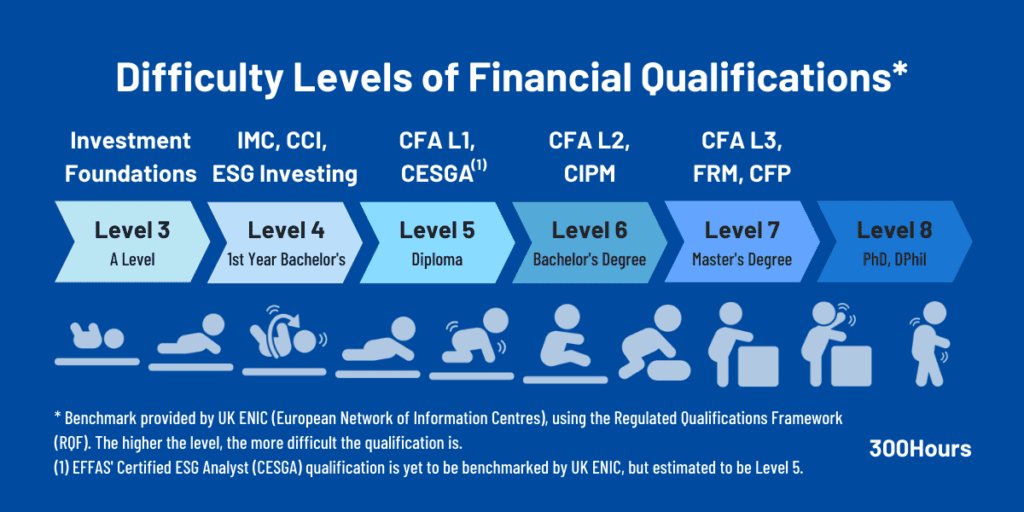
According to UK NARIC, the CFA exams have been benchmarked individually by Level under UK Regulated Qualifications Framework (RQF):
- CFA Level 1‘s difficulty is comparable to a Diploma of higher education (Level 5 qualification under RQF);
- CFA Level 2‘s difficulty is comparable to a Bachelor’s degree (Level 6 qualification under RQF);
- CFA Level 3‘s difficulty is comparable to a Master’s degree (Level 7 qualification under RQF).
Cumulative difficulty: Completing all three CFA levels is academically equivalent to earning both a Bachelor’s AND a Master’s degree in finance—while working full-time. This validates the charter’s prestige and explains why only 10-15% of Level 1 candidates eventually earn the designation.
Frequently asked questions about CFA pass rates
As of May 2026: Level 1 is 39%, Level 2 is 43%, and Level 3 is 50%. These rates represent a recovery from pandemic-era lows and track closer to historical averages.
Pass rates vary by exam window—May exams have historically shown slightly higher pass rates than August or November exams, though CFA Institute states exam difficulty remains constant.
Level 1: 22% (July 2021). Level 2: 29% (August 2021). Level 3: 39% (May 2021, August 2021).
These pandemic-era lows were anomalous — CFA Institute attributed them to pandemic disruption affecting candidate preparation quality, not intentional exam difficulty increases. Pass rates have since recovered toward historical norms.
No. CFA Institute explicitly states exam difficulty remains constant year-over-year through their “just competent candidate” minimum passing score methodology.
The pandemic-era pass rate drop (2020-2021) reflected degraded candidate preparation quality due to pandemic disruption, not increased exam difficulty.
Recovery toward historical averages (2023-2025) confirms this explanation. The exam is no harder today than in 2015.
Natural selection. Level 1 attracts exploratory candidates testing their interest, including many unprepared or uncommitted test-takers. Candidates who pass Level 1 and choose to continue are more serious, skilled, and committed.
Level 3 candidates have already demonstrated competence by passing two rigorous exams, resulting in a higher-quality candidate pool and higher pass rates (50% average vs 41% for Level 1).
CFA pass rates (40-56%) are comparable to peer credentials: CPA (45-55%), FRM (40-60%), CMA (35-50%), CIA (40-50%). Bar exam pass rates vary widely by state (40-80%). Medical licensing exams (USMLE) pass at 92%+ but require extensive prerequisites. Acturial (SOA) is 30-50% per exam.
CFA’s 40-56% pass range is typical for prestigious, open-entry professional certifications.
The data suggests caution. Deferred candidates pass at 20-25 percentage points lower than first-timers (example: Nov 2025 Level 1 first-timers 49% vs deferred 29%).
Unless you have a clear plan to dramatically improve preparation during deferral, taking the exam as scheduled (even if borderline prepared) may be better. The experience itself has value, and many “borderline” candidates pass.
Hope you found the statistics above useful!
Meanwhile, here are some related articles that may be of interest:
Thanks for this valuable data !
How do you explain such a massive and sustained drop in candidate volume ?
I understand that the pandemic had a significant impact, but I am very surprised that the candidate volume has not picked up yet :
volumes are way below half of what they were pre-pandemic for every single level.
I must be missing something.
“The decline in registrants for the CFA exam can partly be attributed to a downturn in test takers in China, the CFA Institute said. ”
Source:https://www.investmentnews.com/rias/cfa-designation-still-in-demand-for-hiring-as-fewer-pursue-it/258470#:~:text=There%20were%20163%2C000%20registrations%20for,China%2C%20the%20CFA%20Institute%20said.
Do you have any guesses on the MPS (approximately) on the Nov/2022 exam?
Yes we do, check out our latest CFA MPS estimates here.
I gave cfa level 1 on 21st Feb 2022.. i was fully prepared.. and i feel that actual exam was much harder than mock exams of cfa institute.. there were so many tough questions.
Hi Anuj, no worries, it’s a common feeling… Fingers crossed for you when the results are out!
CFA Level 2 is much tougher exam than bachelor’s exam.I consider it equivalent to master’s exam.
1000%
Hmmm seems like L2 & 3 could both be bucketed in the “Master’s Degree” level. L2 complexity definitely exceeds a bachelor degree in finance/economics.
You’re not wrong there!
L2 is comparable to a bachelors degree? Bis wtf moment🤣
Because you think L2 is tougher than a bachelors, or easier?
CFA Level 2‘s difficulty is comparable to a Bachelor’s degree my ass
I’m not disagreeing with that!
How close or different is CFA Level 1 to CFA Investment Foundations?
CFA Level 1 is considered a harder-level exam. For more information, see our Investment Foundations Guide here.
Thank you very much for the information. Very useful indeed.