In investment management, being able to measure, attribute, and clearly communicate portfolio performance isn’t just a technical skill – it’s a trust-building function that clients, regulators, and employers increasingly expect to be in expert hands.
CIPM® (Certificate in Investment Performance Measurement) is the only professional credential dedicated specifically to this discipline. Offered by CFA Institute – the same organization behind CFA Program – it equips investment professionals with the practical skills to evaluate performance, measure risk, select managers, and report results to the highest global standards.
To inform this guide, we spoke with Rob Langrick, Chief Product Advocate at CFA Institute – himself both a CFA charterholder and CIPM certificant. His crucial insights on who the CIPM Program is really for, which careers it unlocks, and where its value is heading are woven throughout the sections below.
What is the CIPM designation?

The Certificate in Investment Performance Measurement (CIPM) is a globally recognized professional designation issued by CFA Institute, focused entirely on investment performance evaluation, risk measurement, manager selection, and GIPS® (Global Investment Performance Standards) reporting. It is the only credential of its kind – and the only formal training program built around GIPS Standards, the reporting framework used by more than 1,600 organizations worldwide, including the top 25 asset managers globally.
Where the CFA Program covers the full breadth of investment analysis and portfolio construction, the CIPM occupies a distinct and complementary layer: how well a portfolio has performed, why it performed that way, and how those results should be fairly communicated to investors.
| Key features | CIPM designation at a glance |
|---|---|
| Issued by | CFA Institute |
| Number of levels | 2 (Level I and Level II) |
| Study hours | An average of 155 hours per level (~310 hours total) |
| Level I format | 100 multiple-choice questions, 3 hours |
| Level II format | 80 scenario-based questions, 3 hours |
| Pass rates | Average 5 year pass rates: Level I (39%), Level II (42%) |
| Exam windows | March and September annually |
| CFA charterholder exemption | CFA charterholders or CFA candidates who passed Level 3 can bypass CIPM Level I, heading straight to CIPM Level II. |
| Entry requirements | No prerequisites needed. |
| Work experience required | To use the CIPM designation, 4,000 hours of relevant experience over a minimum of 36 months (CFA Institute regular membership requirement) |
| CPD to maintain designation | 15 credits per year |
CIPM exam structure & topics
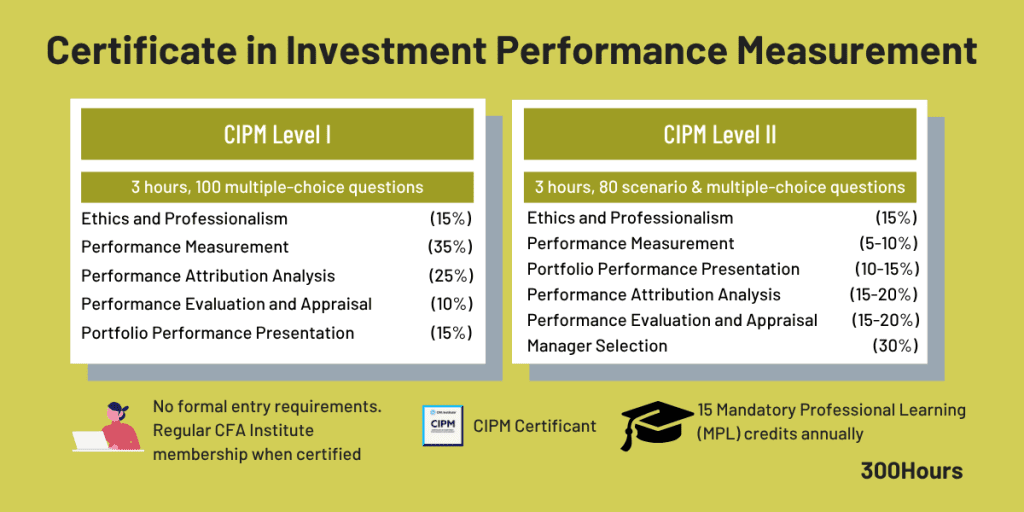
The CIPM Program consists of two sequential levels, each requiring approximately 155 hours of study. Exams are offered in March and September, meaning highly motivated candidates can complete both levels within 12 months.
Level I: Performance measurement foundations
Level I focuses on the technical foundations – how returns are calculated, attributed to decisions, and presented to stakeholders.
| CIPM Level I Topic | Exam Weight |
|---|---|
| Ethics & Professionalism | 15% |
| Performance Measurement | 35% |
| Performance Attribution Analysis | 25% |
| Performance Evaluation and Appraisal | 10% |
| Portfolio Performance Presentation | 15% |
Level II: Advanced appraisal & manager selection
Level II shifts decisively toward manager selection – the skill most valued by employers who use CIPM certificants to evaluate external fund managers.
| CIPM Level II Topic | Exam weight |
|---|---|
| Ethics & Professionalism | 15% |
| Performance Measurement | 5–10% |
| Portfolio Performance Presentation | 10-15% |
| Performance Attribution Analysis | 15–20% |
| Performance Evaluation and Appraisal | 15-20% |
| Manager Selection | 30% |
CFA charterholders, and candidates who have successfully passed CFA Level III exam, can bypass CIPM Level I entirely and register directly for CIPM Level II.
CIPM exam dates

Both levels of CIPM exams are held twice a year in March and September at proctored test centers in over 400 locations worldwide. This means candidates can, in theory, complete both levels within a single calendar year if they pass consecutively.
| CIPM registration deadlines | September 2026 | March 2027 (estimated) |
|---|---|---|
| Registration opens | 2 Mar 2026 | 1 Sep 2026 |
| Early registration deadlines | 1 Jun 2026 | 1 Dec 2026 |
| Registration closes | 31 Jul 2026 | 30 Jan 2027 |
| Scheduling deadline | 22 Sep 2026 | 23 Mar 2027 |
| CIPM exam window | 16-30 Sep 2026 | 16-31 Mar 2027 |
CIPM exam fees
In terms of cost, CIPM is meaningfully more accessible than broader credentials like the CFA Program.
There are no one-off enrollment fees, so the CIPM exam fee is US$575 for early registration and $775 for standard registration. Once you passed CIPM Level II, there is a CFA Institute membership fee of $299 a year required to use the designation.
Exam retake fees are the same as registration fees ($575-775), and there is a $25 rescheduling fee if you need to use that option.
Historical CIPM pass rates

The latest pass rates for CIPM are 34% for Level I and 52% for Level II (Sep 2025).
Since 2020, the average 5 year pass rates for CIPM are 39% for Level I and 42% for Level II. In this period, Level I pass rate ranges from 27%-59%, while Level II 29%-59%.
How hard are CIPM exams?
While CIPM pass rates provides a reasonable gauge of difficulty, perhaps a more consistent and objective way to assess CIPM exams’ difficulty lies in the UK ENIC’s (National Information Centre) benchmarks.

According to UK ENIC, the CIPM exams have been benchmarked individually by Level under UK Regulated Qualifications Framework (RQF):
- CIPM Level I’s difficulty is comparable to a Diploma of higher education (Level 5 qualification under RQF);
- CIPM Level II’s difficulty is comparable to a Bachelor’s degree (Level 6 qualification under RQF);
How do you earn the CIPM designation?

Earning the CIPM designation involves four steps:
| Step | What’s required |
|---|---|
| 1. Enroll and register | Register for CIPM Level I on the CFA Institute website (or Level II directly if you’re a CFA charterholder or have passed CFA Level III exam). There are no formal entry requirements for the exams themselves. |
| 2. Pass both exam levels | Complete Level I and Level II sequentially. Exams are offered in March and September each year. |
| 3. Join CFA Institute as a regular member | Membership requires 4,000 hours of relevant professional experience accumulated over a minimum of 36 months. |
| 4. Maintain your designation | Complete at least 15 Mandatory Professional Learning (MPL) credits each year to keep the designation active. |
The study materials for the CIPM Program are delivered entirely online through CFA Institute’s Learning Ecosystem – a self-paced digital platform that includes the full curriculum, personalized study plans, flashcards, and mock exams. This flexibility makes it well-suited to working professionals juggling study alongside a full-time role.
Who is the CIPM designation for?

You’re likely a strong fit for the CIPM Program if you:
- Work in an investment performance, performance attribution, or risk reporting role.
- Are in an investment consulting or manager research function where evaluating external managers is central to your work.
- Work at a firm that claims or is pursuing GIPS compliance, making in-depth knowledge of GIPS Standards commercially valuable.
- Hold a CFA charter and want to deepen your specialist expertise in performance evaluation
- Are moving from a back-office or operations role toward a more client-facing or analytical performance function
The CIPM Program is less well-suited for:
- Those with no exposure to performance roles yet – CFA Program is typically the more strategic starting point, though the CIPM designation remains an option once you’ve begun working in or toward a performance function.
- Generalist finance professionals with no performance reporting responsibilities.
- Those whose career goals are primarily in portfolio management, equity research, or investment banking.
The typical CIPM candidate is already working with investment return data in some capacity, says Rob Langrick, Chief Product Advocate at CFA Institute.
Approximately a quarter work in performance measurement and that’s the biggest slug. We then have professionals in portfolio accounting, risk and investment consulting. We also have a fair few portfolio managers, private wealth managers and research analysts take one or both of the CIPM exams. In essence, anybody touching investment return data.
Rob Langrick, CFA, CIPM – Chief Product Advocate, CFA Institute
On why candidates pursue CIPM, Langrick is clear that the draw is technical depth that’s genuinely hard to find elsewhere: “The CIPM Program is one of the few places where you can go deep into the mathematics of performance attribution, performance measurement and investment risk measurement statistics.”
Perhaps the most surprising group in the CIPM candidate mix is portfolio managers and private wealth managers themselves.
I think of the CIPM Program as “defense against the dark arts”.
Essentially it explains many of the tricks that money managers have done in the past to misrepresent their investment performance to prospective clients and it explains how to smoke out those tricks.
Money managers like to know how they will be judged by asset owners and investment consultants. So a key reason money managers do it is to sharpen their pitch for new investments by knowing how they will be analyzed.
Rob Langrick, CFA, CIPM – Chief Product Advocate, CFA Institute
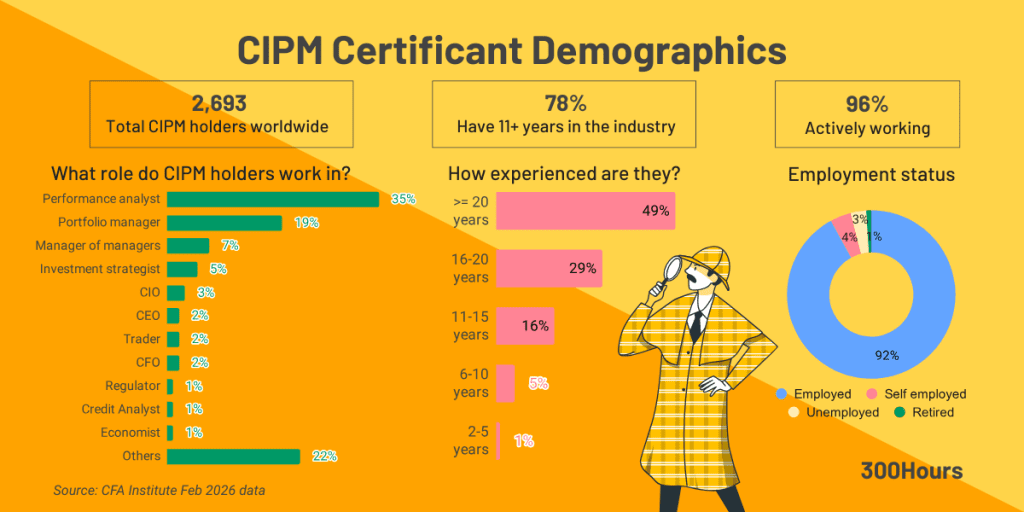
The typical CIPM certificant has significant industry experience – nearly half have 20+ years in the field. But this reflects where the designation has historically been strongest, not a barrier to entry:
- CIPM Program has no formal prerequisites, and earlier-career professionals working in or targeting performance roles can and do pursue it – often with the advantage of building specialist credentials before they become the norm in their function.
- The 19% share of portfolio managers also reflects Rob Langrick’s ‘defense against the dark arts’ point: money managers pursue CIPM to understand how their own performance will be scrutinized.
What jobs & careers does the CIPM unlock?

CIPM sits at the intersection of performance measurement, risk evaluation, and investment reporting – a niche that is growing in importance as investor scrutiny intensifies and GIPS Standards adoption expands globally.
Below are the key roles CIPM certificants commonly move into or advance within:
| Role | What they do | Why CIPM Program helps |
|---|---|---|
| Investment Performance Analyst / Manager | Calculate, verify and attribute portfolio returns, ensuring figures are accurate and GIPS-compliant. | The most direct career destination for CIPM certificants – the curriculum maps precisely to this role. |
| Investment Performance Consultant | Help institutional clients (i.e. pension funds, endowments, family offices) interpret and evaluate their investment managers’ performance. | Level II is specifically designed around this skillset. |
| Portfolio Attribution Analyst | Break down portfolio returns by source: asset allocation, stock selection, currency exposure. | Growing demand as clients ask more sophisticated questions about what is driving performance. |
| Investment Consultant (Manager Research) | Select and monitor external fund managers on behalf of institutional clients. | Level II covers manager evaluation frameworks, due diligence and performance data interpretation. |
| GIPS Verification Specialist | Independently audit asset managers’ compliance with Global Investment Performance Standards. | CIPM is the natural credential for this role – the only formal GIPS Standards training program on the market. |
| Risk Analyst / Risk Manager | Evaluate risk-adjusted return metrics and whether portfolio returns justify the risks taken. | CIPM’s coverage of performance risk statistics applies directly, particularly within asset management firms. |
| Client Reporting Manager | Ensure investment reports are accurate, clearly presented and aligned with agreed standards. | CIPM’s focus on performance presentation and GIPS reporting gives holders a strong foundation. |
| Plan Sponsor / Institutional Investor | Evaluate externally appointed investment managers at pension funds, endowments and sovereign wealth funds. | CIPM certificants bring a structured, standards-based approach increasingly valued in institutional settings. |
The employer breakdown reflects the credential’s specialist focus – nearly half of all CIPM certificants work at asset management or investment firms, with consulting, private wealth, and pension funds accounting for most of the remainder.

Geographically, demand is shifting. Rob Langrick notes strong growth in India, where a significant volume of performance measurement work has been outsourced to, making specialist credentials increasingly valued there. He also points to growing interest from compliance and fund marketing functions globally – driven in part by the fact that the CIPM Program is the only formal training program specifically built around GIPS Standards, the voluntary ethical standards that govern how investment performance is calculated and presented.
For a CFA charterholder specifically, Langrick points to two areas where adding the CIPM certification delivers tangible value:
The first is a shift in perspective: added fluency in performance attribution and manager selection helps you think the way that asset allocators and asset owners think.
The second is private markets fluency – an increasingly important area as allocations to private equity, infrastructure and private credit grow. Learning the whole new language of private markets is important – metrics like DPI (Distributed to Paid-In capital), MOIC (Multiple on Invested Capital) and RVPI (Residual Value to Paid-In capital) are becoming standard in client conversations.
Rob Langrick, CFA, CIPM – Chief Product Advocate, CFA Institute
Is the CIPM designation worth it?

If you’re working in or targeting the performance measurement niche, CIPM certification offers a strong return on investment – both in career terms and in the practical value of the knowledge itself.
For the right professional, it deepens technical expertise in a domain most generalist credentials don’t touch, signals specialist credibility in a way a CFA charter alone cannot, and provides practical GIPS knowledge that institutional employers increasingly expect.
The time and cost commitment is also meaningfully lower than broader credentials. With approximately 155 hours of study per level and an exam schedule that allows both levels to be completed within 12–18 months, the CIPM designation is achievable alongside a full-time role without the multi-year commitment of the CFA Program.
That said, CIPM works best when it connects to real work you are doing or actively targeting. Its value lies in deepening and credentialing expertise you are already building, or in giving early-career professionals a clearly defined specialist track if they know performance is where they want to go.
For CFA charterholders already working in performance roles, the logic is particularly clear: the Level I bypass means a focused, single-level commitment to earn a complementary credential that meaningfully adds to rather than overlaps with CFA Program.
On where the CIPM Program is heading, Langrick sees the global spread of GIPS Standards as the key driver: “As the AUM mix shifts away from the classic North American market, more and more countries are becoming interested in GIPS – and the CIPM Program will ride that global trend.”
On the most underrated benefit (of CIPM), Langrick is specific:
The jewel in the crown is a solid, mathematical grasp of equity and fixed income attribution.
As attribution packages such as Bloomberg PORT, FactSet PA and Aladdin grow in popularity, it is increasingly important to master the mathematics behind them.
You can read Carl Bacon’s book on attribution, which is considered ‘the bible’ – but it has no exam to prove that you have read it and understood it.
Rob Langrick, CFA, CIPM – Chief Product Advocate, CFA Institute
CIPM vs CFA Program: What’s the difference?

Both CIPM Program and the CFA charter are issued by CFA Institute, and are grounded in the same commitment to ethical, rigorous investment practice. But they serve fundamentally different purposes.
| CFA charter | CIPM designation | |
|---|---|---|
| Focus | Broad: financial analysis, economics, portfolio construction, ethics | Specialist: investment performance evaluation, attribution, GIPS Standards, manager selection |
| Scope | Generalist across investment roles | Specialist in performance measurement and reporting |
| Levels | 3 levels | 2 levels |
| Study commitment | 1,000+ hours across all 3 levels | ~310 hours across both levels, less if bypassing CIPM Level I as CFA charterholder |
| Particularly suited for | Broad finance professional seeking the gold-standard credential in asset management and research | Performance professional or CFA charterholder deepening performance measurement skillset |
The key point is that these designations are not in competition – they occupy different layers of the investment process:
- CFA Program covers how to build and analyze portfolios; whereas
- the CIPM covers how to measure and communicate what those portfolios actually delivered.
For a performance specialist, holding both is increasingly seen as the benchmark of professional excellence in the field.
CIPM designation FAQs

In finance, CIPM stands for Certificate in Investment Performance Measurement – a professional designation issued by CFA Institute focused on investment performance evaluation, GIPS Standards, and manager selection.
It should not be confused with the Certified Information Privacy Manager, which shares the same acronym but belongs to the data privacy field.
No. Both are issued by CFA Institute, but they are distinct credentials with different purposes.
Chartered Financial Analyst (CFA) Program is a broad designation covering financial analysis, portfolio construction, and investment management.
CIPM is a specialist credential focused specifically on portfolio performance evaluation, attribution, and GIPS reporting. They are complementary rather than competing.
Yes. CFA charterholders, and candidates who have successfully passed CFA Level III exam, can bypass CIPM Level I and register directly for Level II – making the path to the CIPM designation significantly shorter for those who already hold or are completing the CFA charter.
The CIPM can typically be completed in 12–18 months.
Each level requires approximately 155 hours of study, and exams are offered in both March and September – meaning candidates who pass both levels consecutively can complete the program within a single calendar year.
CIPM certificants commonly work in roles including investment performance analyst or manager, investment performance consultant, portfolio attribution analyst, investment consultant (manager research), GIPS verification specialist, risk analyst, client reporting manager, and institutional investor roles at pension funds and sovereign wealth funds.
For professionals already working in or targeting investment performance, GIPS compliance, or manager evaluation roles, the CIPM offers strong value – specialist credibility, practical GIPS knowledge, and a relatively low time and cost commitment compared to broader credentials.
For generalists without performance exposure, CFA Program is typically the more strategic first step.
There are no formal entry requirements for the CIPM exams themselves.
To earn and use the designation, candidates must pass both Level I and Level II, become a regular CFA Institute member, and accumulate 4,000 hours of relevant professional experience over a minimum of 36 months.