ACCA exams quick summary:
- 15 papers exist across 3 levels; a candidate sits 13, since Strategic Professional requires choosing 2 of 4 Options papers
- 2026 fees: £3,313-£8,373 total across registration, subscription, exemptions, and all exam entries
- Pass rates range from 87-89% (Business and Technology) to 38-42% (Advanced Audit and Assurance, Advanced Performance Management)
- Study time: roughly 5,300 total learning hours per ACCA’s own framework, or 100-300 hours per paper in practical terms
- Typical completion time: 3-4 years, driven partly by the 36-month Practical Experience Requirement
- Restructures from September 2027: levels renamed, one paper retired outright, Strategic Professional Options reduced from 2 to 1
Considering the ACCA qualification and wondering what it’s all about?
Whether you’re a current candidate or completely new to ACCA, here’s our epic guide summarising everything you need to know: the exam structure, costs, requirements, pass rates, and how to prepare.
What is ACCA?

ACCA (Association of Chartered Certified Accountants) is a UK-headquartered professional body founded in 1904, with 266,174 members and 546,534 future members (students and affiliates) across 179 countries as of March 2026.
| Year | ACCA members |
|---|---|
| 2021-22 | 240,952 |
| 2022-23 | 247,734 |
| 2023-24 | 252,562 |
| 2024-25 | 257,956 |
| 2025-26 | 266,174 |
Employer satisfaction with ACCA rose to 83.2% in the year to March 2026, and 86% of employers rate ACCA as highly regarded in their market.
As of May 2026, ACCA works with over 8,104 Approved Employers and 737 strategic partnerships worldwide, from Big 4 firms to global banks and multinationals, giving members and students a genuinely global base of recognised employers to build a career with.
Completing the ACCA Qualification and meeting all requirements makes you an ACCA member, a recognised professional designation rather than a government-issued license. In most of ACCA’s core markets, including the UK, much of Asia, the Middle East, and parts of Africa, ACCA membership functions as the practical standard for a qualified accountant.
ACCA exam structure
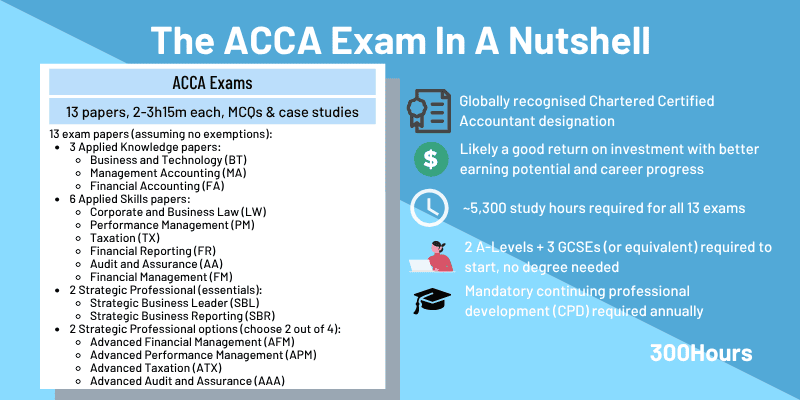
ACCA has 15 total papers across three levels: Applied Knowledge, Applied Skills, and Strategic Professional. An individual candidate sits 13 of them, since Strategic Professional requires 2 compulsory Essentials plus a choice of 2 from 4 Options papers, not all 4.
Two requirements govern the order you sit these in: Applied Knowledge must be completed or exempted before Applied Skills, and Applied Skills before Strategic Professional. Within each level, the order is your choice. See our ACCA exam order guide for our recommended sequence and the reasoning behind it.
The table below summarises the key exam format for each ACCA paper. There are 3 types of questions in ACCA exams:
- objective test (OT) questions have one correct answer marked automatically by computer,
- multi-task questions (MTQ) bundle several OT-style questions around one scenario, and
- constructed response (CR) questions are fully written answers marked by a human examiner.
| Paper | Level | Duration | Format | Questions | Exam window |
|---|---|---|---|---|---|
| Business and Technology (BT) | Applied Knowledge | 2 hours | 100% OT | 52 (46 OT + 6 MTQ) | On-demand |
| Management Accounting (MA) | Applied Knowledge | 2 hours | 100% OT | 38 (35 + 3 MTQ) | On-demand |
| Financial Accounting (FA) | Applied Knowledge | 2 hours | 100% OT | 37 (35 + 2 MTQ) | On-demand |
| Corporate and Business Law (LW) | Applied Skills | 2 hours | 100% OT | 50 (45 + 5 MTQ) | On-demand |
| Performance Management (PM) | Applied Skills | 3 hours | OT + CR | 32 (15 + 15 + 2) | Quarterly |
| Taxation (TX) | Applied Skills | 3 hours | OT + CR | 33 (15 + 15 + 3) | Quarterly |
| Financial Reporting (FR) | Applied Skills | 3 hours | OT + CR | 32 (15 + 15 + 2) | Quarterly |
| Audit and Assurance (AA) | Applied Skills | 3 hours | 30% OT, 70% CR | 18 (15 + 3) | Quarterly |
| Financial Management (FM) | Applied Skills | 3 hours | OT + CR | 32 (15 + 15 + 2) | Quarterly |
| Strategic Business Leader (SBL) | Strategic Professional | 3 hours 15 min | 100% CR | 3 tasks | Quarterly |
| Strategic Business Reporting (SBR) | Strategic Professional | 3 hours 15 min | 100% CR | 4 questions | Quarterly |
| Advanced Financial Management (AFM) | Strategic Professional | 3 hours 15 min | 100% CR | 3 questions | Quarterly |
| Advanced Performance Management (APM) | Strategic Professional | 3 hours 15 min | 100% CR | 3 questions | Quarterly |
| Advanced Taxation (ATX) | Strategic Professional | 3 hours 15 min | 100% CR | 3 questions | Quarterly |
| Advanced Audit and Assurance (AAA) | Strategic Professional | 3 hours 15 min | 100% CR | 3 questions | Quarterly |
Pass mark is a fixed 50% across all 15 papers. Full detail, technique, and syllabus-specific tips for each paper are in our ACCA exam tips hub.
ACCA exam tips
We’ve summarised a dedicated tips guide for every paper, based on ACCA’s own examiner’s reports and what past candidates say actually worked, plus 15 general ACCA exam tips that apply across the whole qualification.
Check these out:

ACCA General Exam Tips

BT Exam Tips

MA Exam Tips

FA Exam Tips

LW Exam Tips

PM Exam Tips

TX Exam Tips

FR Exam Tips

AA Exam Tips

FM Exam Tips

SBL Exam Tips

SBR Exam Tips

AFM Exam Tips

APM Exam Tips

ATX Exam Tips

AAA Exam Tips
ACCA exam dates and booking

Applied Knowledge papers and Corporate and Business Law (Applied Skills) are available on-demand, so you can book and sit them whenever you’re ready. Every other paper is sat quarterly, in March, June, September, and December.
See our ACCA exam dates guide for the latest sitting windows, and our ACCA exam booking, registration and deferrals guide for the full admin process.
ACCA fees and costs

Full ACCA fees, including registration, annual subscription, exemptions, and exam entries across all 13 papers costs £3,313 to £8,373. That range reflects how many papers you’re exempt from and whether you sit any papers late.
This surprises most people expecting ACCA to be the cheaper route compared to other accounting qualifications, since it charges repeatedly across many separate papers rather than a smaller number of larger exams. See our full ACCA fees breakdown for exact current figures.
ACCA requirements and exemptions

ACCA has flexible entry points. You can start with as little as two A-Levels or equivalent qualifications, or enter with a relevant degree and claim exemptions.
Exemptions can reduce your total paper count by up to 9, based on a relevant prior degree or professional qualification, though this only applies at Applied Knowledge and Applied Skills level. Nobody is exempted from Strategic Professional.
See our full ACCA requirements guide for entry criteria, and our ACCA exemptions guide, plus ACCA’s own exemptions calculator, to check your specific case.
ACCA pass rates and difficulty

Pass rates vary enormously by paper, more than almost any other finance qualification. Business and Technology has run 87-89% recently, while Advanced Audit and Assurance and Advanced Performance Management have both run closer to 38-42%.
The pattern is consistent: Exam papers get harder as you progress through the three levels, and the shift from objective test to fully written constructed response by Strategic Professional is a real technique change, not just more content. See our full ACCA pass rates breakdown by paper.
How to study for ACCA

The most effective approach combines ACCA’s own resources with the right paid or free provider for your budget and study style.
ACCA publishes genuine past exam papers and specimen exams through its CBE Practice Platform, a real advantage over qualifications like CFA or CPA that don’t release real past questions. Combine this with our 15 ACCA exam tips, drawn directly from examiner’s reports across every paper.
For choosing a provider, see our best ACCA online courses guide, comparing 9 providers on verified pricing, accreditation, and study format.
ACCA exam day and results

See our ACCA exam day checklist for what to expect and bring, and our ACCA exam results guide for how results, reviews, and appeals work.
What are the benefits of ACCA?

- Genuine global mobility. ACCA is recognised in over 180 countries, more geographic reach than most single-country accounting qualifications offer.
- A large, recognised employer network. As of May 2026, ACCA works with over 8,104 Approved Employers and 737 strategic partnerships worldwide, from Big 4 firms to global banks and multinationals.
- Flexible entry points. You can start with as little as two A-Levels or equivalent qualifications, or enter with a relevant degree and claim exemptions, unlike qualifications with a single fixed entry route.
- A broad skill set. The syllabus spans financial accounting, management accounting, audit, tax, corporate law, financial management, and strategic leadership, rather than one narrow specialism.
- Genuine past exam papers. ACCA’s CBE Practice Platform gives you real past questions and specimen exams, an advantage over qualifications like CFA or CPA that don’t release real past exam content.
ACCA careers and salary

ACCA members work across audit, financial accounting, management accounting, corporate finance, and advisory roles, in multiple industries and geographies. In the UK specifically, ACCA finalists earn £35k-£70k, rising to £65k-£110k with 5 or more years of post-qualified experience.
See our full ACCA careers guide for the roles behind these numbers, and our ACCA salary guide for the full breakdown by career stage and region.
Is ACCA worth it?

It depends on your career goal and where you plan to work, not a universal yes or no. It’s a strong investment for candidates targeting global, IFRS-focused accounting careers, Big 4 firms, or multinational corporates, especially outside the US. It’s a weaker fit if you need a specific national license ACCA doesn’t grant, or if you’re unlikely to complete the full qualification.
See our full is ACCA worth it analysis for the complete cost, salary, and career breakdown.
ACCA vs other qualifications

ACCA is often compared against other accounting and finance qualifications as part of a candidate’s decision. Here’s a quick overview:
ACCA vs other qualifications
ACCA is often compared against other accounting and finance qualifications as part of a candidate’s decision. Here’s a quick overview:
| Qualification | Description |
|---|---|
| ACCA | A global, UK-administered professional body qualification built around IFRS. Broad accounting qualification valued in audit, corporate accounting, and finance leadership, particularly outside the US. |
| Associate Chartered Accountant (ACA), administered by ICAEW | A UK chartered accountancy qualification with a strong reputation in UK audit and practice specifically. |
| Chartered Institute of Management Accountants (CIMA) | A UK-administered qualification focused specifically on management accounting rather than audit or general practice. |
| Association of Accounting Technicians (AAT) | An entry-level UK accounting qualification, often used as a stepping stone before ACCA rather than a competing end qualification. |
| Certified Public Accountant (CPA), US | A US state-issued license built around US GAAP, required to perform certain regulated accounting work in the US specifically. |
| Chartered Financial Analyst (CFA) | A global investment management qualification focused on securities analysis and portfolio management, not accounting. Suits asset management and equity research over audit or corporate accounting. |
| Financial Risk Manager (FRM) | A global risk management qualification focused on financial and quantitative risk, not accounting. Suits risk management roles at banks and financial institutions. |
| Certified Financial Planner (CFP) | A financial planning qualification focused on personal and retail financial advice, not accounting. Suits client-facing wealth and financial planning roles. |
| Chartered Alternative Investment Analyst (CAIA) | A qualification focused on alternative investments, such as hedge funds, private equity, and real assets, not accounting. Suits roles in alternative asset management specifically. |
If you’re weighing ACCA against a specific accounting alternative, our dedicated comparison guides above cover the fuller picture. CFA, FRM, CFP, and CAIA serve genuinely different career paths to ACCA, worth exploring on their own hub pages if investment management, risk, financial planning, or alternative assets interest you more than accounting itself.
Is ACCA’s format changing in 2027?

Yes, significantly, and it’s worth understanding before you plan a multi-year study sequence. From September 2027, ACCA renames its three levels, renumbers papers, and reduces the Strategic Professional Options requirement from 2 papers to 1. Business and Technology is retired outright and replaced by a new module, not renamed like every other paper.
This is genuinely underreported elsewhere. See our ACCA exam order guide for how this might affect your own study sequence.
FAQs

ACCA (Association of Chartered Certified Accountants) is a global professional accounting qualification administered by a UK-headquartered body, built around International Financial Reporting Standards. Completing it makes you an ACCA member, a widely recognised designation across more than 180 countries.
15 total papers exist across the qualification, but an individual candidate sits 13, since Strategic Professional requires choosing 2 of 4 Options papers rather than all 4.
Full ACCA fees run £3,313 to £8,373, covering registration, annual subscription, exemptions, and exam entries across all 13 papers. This includes a reasonable level of prep provider costs, which vary significantly by provider and study format.
Pass rates vary widely by paper, from 87-89% for Business and Technology down to 38-42% for the hardest Strategic Professional papers. There’s no single blended ACCA pass rate that means much, given this range.
Most candidates complete the qualification in 3 to 5 years while working full-time, driven partly by the 36-month Practical Experience Requirement, which can’t be shortened regardless of exam pace.
ACCA is often treated as functionally equivalent to a professional qualification for employment purposes, though it’s legally a different kind of credential to an academic degree or a government-issued license like the US CPA.
Yes, up to 9 papers, based on a relevant prior degree or professional qualification, though this only applies at Applied Knowledge and Applied Skills level. Check your specific case on ACCA’s own exemptions calculator.
It depends on your career goal. It’s a strong investment for candidates building international, IFRS-focused careers who can commit to finishing the full qualification, and a weaker fit if you need a specific national license ACCA doesn’t grant. See our full is ACCA worth it guide for a framework to evaluate this.
Related articles:
- ACCA Exam Tips: 15 Highly Effective Exam Techniques You Must Know
- Best ACCA Online Courses (2026): Providers, Pricing and Value
- ACCA Exam Order (2026): The Best Sequence for Every Paper
- ACCA vs CPA: Which Is Best For You?
- ACCA vs ACA: Which Accounting Qualification is Best for You?
- ACCA vs CIMA: Which Is Best For Your Accounting Career?
- AAT vs ACCA (2026): Where’s Best to Start Your Career?