
CAIA exam quick summary:
- Structure: 2 levels. Level 1 (200 MCQs, 4 hours) and Level 2 (100 MCQs + 3 constructed-response questions, 4 hours)
- Fees: $1,395-$1,795 per level for new candidates ($995-$1,395 early/standard + $400 one-off enrollment fee for Level 1)
- Pass rates: ~45-60% historically; latest is 45% (L1 March 2026), 60% (L2 Sep 2025)
- Study time: 200 hours per level recommended
- Offered: Twice a year in March and September
- Requirements: bachelor’s degree + 1 year experience, OR 4 years experience, OR be a CFA charterholder
- 14,000+ CAIA members worldwide (April 2026). CFA charterholders can skip Level 1 via stackable credential program.
Best for investment professionals specializing in alternative assets: private equity, hedge funds, real assets, and private debt.
The demand for alternative investments is expected to rise.
According to Blackrock, their institutional clients currently allocate an average of 25% of their portfolios towards alternatives, which is expected to rise to between 30-40%, whereas ordinary investors will increase their alternatives allocation from 3% to 25%. The demand for alternative investment managers is likely to continue to rise in the foreseeable future.
If you’re considering a career in alternative investment management, the CAIA exam (Chartered Alternative Investment Analyst) is worth looking into.
This comprehensive guide is packed with the latest CAIA course details that will help you decide if this designation suits your career goals.
Popular articles:

Free CAIA Study Planner

CAIA Results Dates

CAIA Exam Fees

CAIA Pass Rates

Is CAIA Worth It?
CFA vs CAIA

CAIA Exam Dates

All CAIA Articles
What is the CAIA designation?
Chartered Alternative Investment Analyst (CAIA) is a professional designation for investment professionals offered by the CAIA Association. Aspiring alternative investment professionals need to complete and pass 2 levels of examination.
The CAIA Association – a non-profit organization founded by the Alternative Investment Management Association (AIMA) and the Center for International Securities and Derivatives Markets (CISDM) in 2002 – is the global leader and authority in alternative investment education.
The CAIA Association conducted its first exam in February 2003. Since then, thousands of individuals worldwide have registered for the program, with more than 14,000+ current CAIA members worldwide (April 2026).

There is strong demand for the CAIA certification – CAIA members have grown by an average of 7% per year since 2010.
While the CAIA certification can be perceived as more niche in the alternative investment space, its members’ occupation are more evenly distributed across roles such as portfolio manager, consultant, sales & marketing, analyst, asset allocator, risk manager, fund administration, accounting & legal roles.
Related articles:

Asset Management Outlook

Hedge Fund Career Path

Private Equity Career Path

CAIA Salary
CAIA course details, summarized
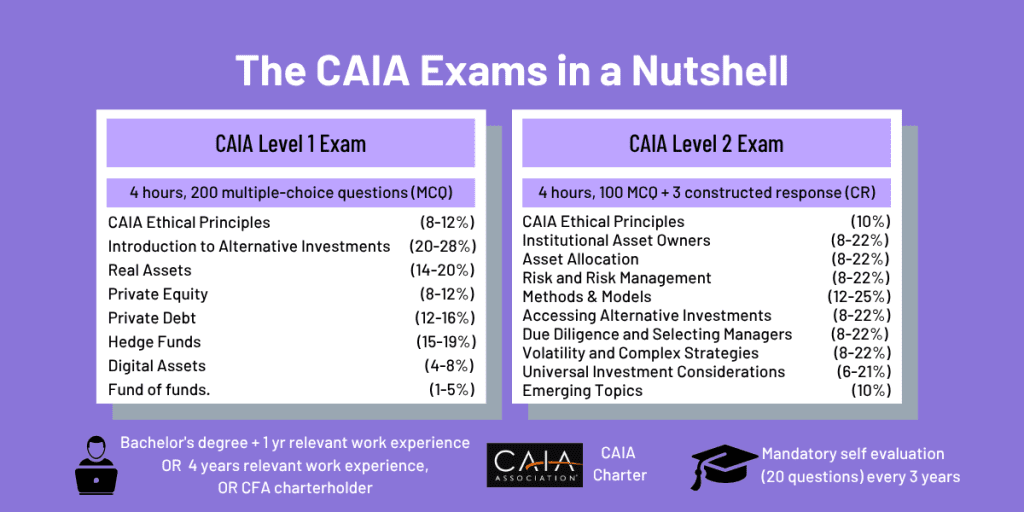
The CAIA certification is a two-part examination, with each exam lasting 4 hours long:
- CAIA Level 1 consists of 200 multiple-choice questions, whereas
- CAIA Level 2 consists of 100 multiple-choice questions in Section 1 (70% exam weight), in addition to 3 sets of constructed-response (essay type) questions in Section 2 (30% of exam weight).
The CAIA Level 1 curriculum concentrates on the fundamentals of alternative investment markets, building up candidates’ understanding of different asset classes.
CAIA Level 2 focuses on more advanced topics in alternative investments by incorporating recent academic and industry research in alternative investments, asset allocation and risk management. Less than 30% of CAIA Level 1 and 2 questions would require calculations.
In terms of study hours, it is recommended that candidates devote at least 200 hours of study time for each level.
CAIA exams take place twice a year during March and September for both levels. The exams are administered via computer at proctored Pearson VUE test centers around the world. You can find your nearest exam center here.
CAIA exams are conducted exclusively at proctored Pearson VUE test centers worldwide. Online proctored exams are only available under limited, special circumstances – check CAIA Association for current policy.
There are no negative markings for incorrect answers in the exams. The passing score is determined by CAIA Association each year, although candidates who earn 70% or more are assured of passing the exam.
The exam results are sent to candidates via email around 3 and 6 weeks after the last exam for Level 1 and Level 2 candidates respectively. The result is simply a pass or fail, but candidates will be provided with performance report to understand the areas of relative strength and weakness compared to a reference group.
What are the CAIA pass rates?

| CAIA exam window | Level 1 pass rate | Level 2 pass rate |
|---|---|---|
| Mar-21 | 54% | 59% |
| Sep-21 | 51% | 58% |
| Mar-22 | 49% | 58% |
| Sep-22 | 49% | 57% |
| Mar-23 | 45% | 61% |
| Sep-23 | 48% | 65% |
| Mar-24 | 46% | 59% |
| Sep-24 | 45% | 60% |
| Mar-25 | 48% | 62% |
| Sep-25 | 46% | 60% |
| Mar-26 | 45% | 64% |
The latest Mar 2026 CAIA exam pass rates are 45% for Level 1 and 64% for Level 2.
- Since 2011, CAIA Level 1 pass rates continues its downward trend and remained below 70%, compared to the earlier periods of 2006-2011.
- CAIA Level 2 pass rates ranges from 56%-70% since 2006 (with the exception of March 2020’s one-off spike), seemingly moving in a cyclical manner.
- The average pass rates for CAIA Level 1 and Level 2 since 2021 are 48% and 60% respectively.
For more detailed commentary and analysis, check out our article on CAIA historical pass rates and how to gauge its difficulty.
What topics are on the CAIA exams?
CAIA Level 1
The CAIA Level 1 exam mainly focuses on the introduction to alternative investments by covering the various asset classes. The topics areas and exam weights are as below:
| CAIA Level 1 Topics 2026 | Weighting |
|---|---|
| CAIA Ethical Principles | 8%-12% |
| Introduction to Alternative Investments | 20-28% |
| Real Assets | 14%-20% |
| Private Equity | 8%-12% |
| Private Debt | 12%-16% |
| Hedge Funds | 15%-19% |
| Digital Assets | 4%-8% |
| Fund of Funds | 1%-5% |
CAIA Level 2
The Level 2 exam builds on the foundation of Level 1 and adds on recent academic and industry research in alternative investments, asset allocation, and risk management.
CAIA Level 2 is unique in the sense that the exam is split into 2 sections of 2 hour each, consisting of 100 multiple-choice questions (Section 1) and 3 sets of constructed-response questions (Section 2). Despite the equal time allocation per section, the multiple-choice section forms majority (70%) of the Level 2 exam weight, and the essay-type questions only 30%.
| CAIA Level 2 Topics | Multiple Choice Topic Weight | Constructed-Response Topic Weight |
|---|---|---|
| CAIA Ethical Principles | 0% | 10% |
| Institutional Asset Owners and Investment Policies | 8%-12% | 0%-10% |
| Asset Allocation | 8%-12% | 0%-10% |
| Risk and Risk Management | 8%-12% | 0%-10% |
| Methods and Models | 12-15% | 0%-10% |
| Accessing Alternative Investments | 8%-12% | 0%-10% |
| Due Diligence and Selecting Managers | 8%-12% | 0%-10% |
| Volatility and Complex Strategies | 8%-12% | 0%-10% |
| Universal Investment Considerations | 6%-11% | 0%-10% |
| Emerging Topics | 0% | 10% |
| Total | 70% | 30% |
Related articles:

HP12C Guide

BA II Plus Guide
Free CAIA Study Planner

Best CAIA Study Materials
How much does CAIA exam cost?

CAIA exam fees are quite straightforward.
The exam fees are the same for each Level, and only vary depending on:
- the date of registration and
- whether you’re a new or returning candidate.
| Fee Type (for all Levels) | CAIA Fees (per Level) |
|---|---|
| 1) One-off Enrollment Fee (paid once only during the first CAIA registration) | $400 |
| 2) Exam Registration Fee (only applicable to first time Level 1 or Level 2 candidates) | |
| Early Registration | $995 |
| Standard Registration | $1,395 |
| 3) Exam Registration Fee for Retakes (if applicable) | $795 |
There is a one-off enrollment fee of $400 that applies to first time CAIA candidates. For new Level 1 or Level 2 (via Stackable credential program) CAIA candidates, the total fees would be $1,395-$1,795 assuming Early registration and includes the one-off enrollment fee.
Exam retake fees for both levels are slightly cheaper, at $795 per retake per level.
CAIA Association membership is required to obtain and maintain your charter: $350/year or $650 for 2 years.
For more details on the full CAIA certification’s costs, see this article.
When are CAIA exams offered?

Both levels of CAIA exams are conducted twice a year in March and September. This provides candidates the opportunity to complete the CAIA program within 1 year, if they passed consecutively. That said, CAIA Level 1 and Level 2 exams cannot be taken within the same exam window.
Candidates have the option of booking their exam date in a 10 business day window during the exam periods. All exams are administered internationally in computerized format exclusively at proctored Pearson VUE test centers.
| CAIA Registration Deadlines | Sep 2026 CAIA Exams (Level 1 and 2) | Mar 2027 CAIA Exams (Level 1 and 2) |
|---|---|---|
| Registration Opens | 13 Apr 2026 | 12 Oct 2026 |
| Early Registration Deadline | 8 Jun 2026 | 7 Dec 2026 |
| Registration Closes | 3 Aug 2026 | 1 Feb 2027 |
| CAIA Level 1 Exam Window | 31 Aug – 11 Sep 2026 | 1-12 Mar 2027 |
| CAIA Level 2 Exam Window | 14-25 Sep 2026 | 15-26 Mar 2027 |
For the latest exam dates and FAQ, check out our CAIA exam dates article.
Related articles:

Passed CFA L3, Now What?

CAIA Stackable Program

Finance Career Quiz

Finance Career Change Tool
What are the CAIA charter requirements?

In order to obtain the CAIA designation, candidates must have the following prerequisites:
- Passed both Level 1 and Level 2 exams. CFA charterholders are eligible to skip Level 1 entirely via the CAIA stackable credential program – they only need to pass Level 2 to earn the CAIA charter.; and
- Work experience requirements:
- Holds a bachelor’s degree or its equivalent, and have more than 1 year of full-time professional experience within the regulatory, banking, financial or related fields; OR
- Alternatively, a candidate must have at least 4 years of full-time professional experience within the regulatory, banking, financial or related fields, OR
- Be a CFA charterholder in good standing.
- Paid for CAIA Association Membership (1 or 2 years); and
- Abide by the Member Agreement.
Unlike the FRM certification, CAIA candidates have unlimited time to pass the Level 2 exam after passing Level 1 to qualify for the CAIA Charter.
What are the benefits of CAIA designation?
The CAIA charter is a globally recognized designation, known as the benchmark for best practice in the alternative investment profession. Earning the CAIA designation sets you apart as a financial professional with the knowledge, skills, and experience necessary to provide sound advice on alternative investment strategies.
Once you earn the CAIA designation, you can expect to:
- Differentiate yourself and further boost your alternative investments credentials in the financial industry
- Be recognised and respected among employers, peers, and clients as a knowledgeable expert in alternative investing.
- Increase your career opportunities and enhance your earning potential.
- Broaden your client base and professional networking connections through membership and global chapters.
CAIA vs CFA – Which is right for you?
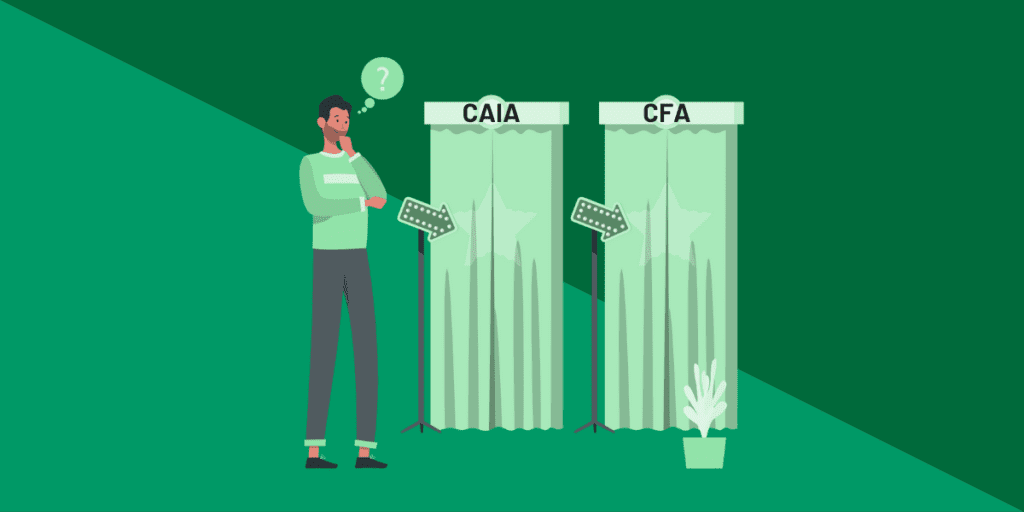
In short, CAIA is highly specialized and has a stronger focus on alternative investments, whereas the CFA designation covers a broader scope of financial analysis, portfolio management and investment topics.
This is a popular topic which warrants a whole article in itself.
We compare the differences and similarities between these designations, in terms of syllabus, difficulty and career objectives. Do check it out!
CAIA exam FAQs

New candidates pay a one-off $400 enrollment fee plus registration of $995 (early) or $1,395 (standard) per level. Total for both levels ranges from $2,390 (both early, including enrollment) to $3,190 (both standard). Retakes cost $795 per level. CAIA membership to obtain the charter costs $350/year or $650 for 2 years. Digital curriculum is included with registration. See our full CAIA cost guide for a complete breakdown.
Moderate difficulty – easier than CFA but more specialized.
Level 1 pass rates average 48% since 2021, Level 2 average 60%. The latest March 2026 pass rates are 45% for Level 1 and 64% for Level 2. Level 1 is more volatile quarter to quarter. Level 2 is harder to study for due to the constructed-response essay section, which requires written answers rather than just MCQ recognition.
To earn the charter you need to pass both Level 1 and Level 2 exams, meet work experience requirements (bachelor’s degree plus 1 year relevant experience, or 4 years experience without a degree, or be a CFA charterholder), and hold CAIA Association membership. CFA charterholders can skip Level 1 entirely via the stackable credential program. There is no time limit to complete Level 2 after passing Level 1.
As little as 12-18 months – 75% of candidates who earn the charter do so within this timeframe. Since both levels are offered in March and September, you can sit Level 1 in March and Level 2 in September of the same year. With 200 recommended study hours per level, most working professionals take 3-5 months to prepare for each exam.
Yes if you work in or want to move into alternative investments. CAIA is the globally recognized standard for alternative asset professionals covering private equity, hedge funds, real assets, private debt and digital assets.
With institutional alternatives allocation growing rapidly, demand for credentialed alternatives professionals is rising. Less recognized than CFA for general investment roles, but far more relevant for specialist alternatives positions. See our CAIA vs CFA comparison for a full breakdown.
Yes. CFA charterholders can earn the CAIA charter by passing only Level 2 via the stackable credential program – Level 1 is waived entirely. This makes CAIA a practical add-on for CFA charterholders wanting to specialize in alternatives. Registration fees and membership requirements still apply. See CAIA Association’s stackable credential page for eligibility details and registration steps.
Are you considering CAIA, as well as the CFA designation? Share your thought process with us below!
Meanwhile, you may find these related articles of interest: