Need help with your FRM preparation? The FRM curriculum is broad and the exam rewards application over memorization, so a generic “study hard” approach isn’t enough. Here are 9 tips, built from what actually works across finance exam preparation, to help you pass efficiently.
Quick summary for your FRM preparation
- Start early and space out your studying, GARP recommends an average of 240 hours per part, spread over 4-6 months
- Use a study plan and track your weak topics with actual scores, not just a feeling
- Allocate study hours by topic weight, not evenly across the curriculum
- Know your exact pace: 2.4 minutes per question for Part 1, 3 minutes for Part 2
- Save the last 3-4 weeks for full timed mock exams, not new content
- Master your calculator before exam day, don’t leave it to the last week
1. Plan ahead and space out your studies

You can’t walk in and expect to pass FRM exams on cramming alone. Just like the CFA exams, you’ll need to commit early and plan your studies ahead, especially when juggling this with work and/or family life.
Starting early and spacing out your studying, rather than cramming, has real advantages:
- You study all topics properly instead of skipping one due to poor time management
- Spacing your studying over a longer period with constant review improves memory retention
- You allocate adequate time to study, review, and practice, rather than rushing at the end
2. Use a study plan for your FRM exam preparation
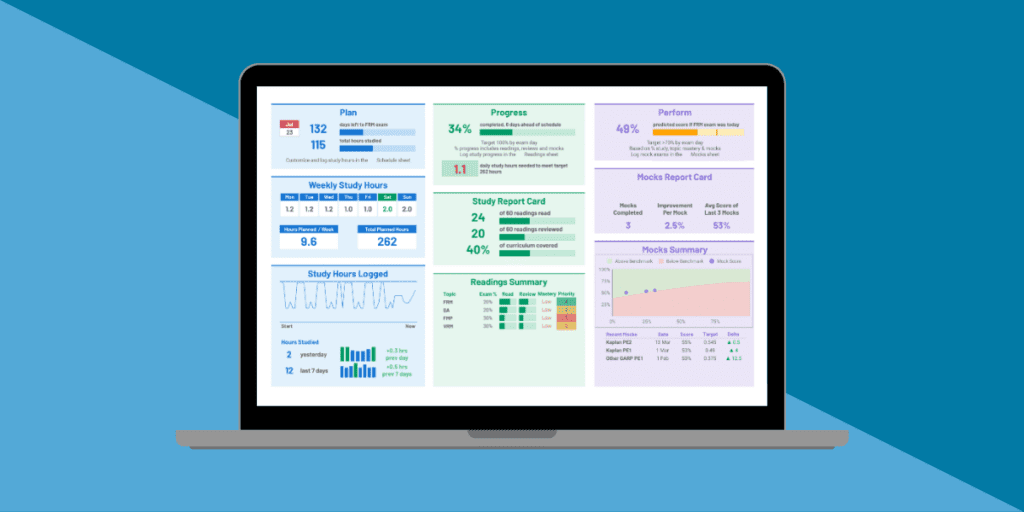
One of the best ways to plan ahead and monitor your progress is by structuring a study plan right from the start. This keeps you in check, ensures you’re constantly building knowledge toward exam day, and alerts you early if work circumstances are affecting your preparation.
“If you register for November, about 5 months before, I would lay out a study plan, plan in some slack, and just commit to it. How are you going to study for this?
How are you going to take the practice exams?
How are you going to find the time in case work gets tough and you have to miss a few study sessions?”
You don’t have to build a study planner from scratch. Get your free FRM study planner from 300Hours.
3. Allocate study time by topic weights

Not all FRM topics deserve equal time. Once you know your total study hours, break them down by how much each topic is actually weighted on the exam, rather than spreading your time evenly or following the curriculum order blindly.
For Part 1, based on GARP’s published exam weights and a 250-hour study target:
| Topic | Exam weight | Suggested study hours |
|---|---|---|
| Foundations of Risk Management | 20% | ~50 hours |
| Quantitative Analysis | 20% | ~50 hours |
| Financial Markets and Products | 30% | ~75 hours |
| Valuation and Risk Models | 30% | ~75 hours |
For Part 2:
| Topic | Exam weight | Suggested study hours |
|---|---|---|
| Market Risk Measurement and Management | 20% | ~50 hours |
| Credit Risk Measurement and Management | 20% | ~50 hours |
| Operational Risk and Resiliency | 20% | ~50 hours |
| Liquidity and Treasury Risk Measurement and Management | 15% | ~38 hours |
| Risk Management and Investment Management | 15% | ~38 hours |
| Current Issues in Financial Markets | 10% | ~25 hours |
One method we prefer when studying for finance exams is the “sandwich method”, alternating between more difficult and easier topics to keep momentum going, rather than clustering all your hardest content together.
We also recommend studying a higher-weighted topic with a lower-weighted one right after in the same study block. For example, pairing Market Risk (higher weighted, heavier content) with Liquidity and Treasury Risk (lower weighted) in Part 2 keeps things moving without losing steam on the heavy topics.
Studying in curriculum order is fine too, but be mindful of time management so you don’t run short on the larger topics that often sit later in the syllabus.
4. Use official readings as your base, and go beyond them for practice

Your core preparation should come from GARP’s own curriculum and readings. Once that foundation is in place, it’s worth going beyond the official reading list for extra practice.
At the end of each reading, work through the practice questions provided and record your score as a percentage. This is a worthwhile endeavour, as it’s your best early indicator of which topics are actually weak versus which just feel unfamiliar. Track these scores in your study plan so you know exactly where to focus your review later, rather than guessing.
Third-party FRM study materials can supplement this well, summarizing dense content and providing a larger volume of practice questions than the official readings alone.
For our full review and breakdown of providers and what each one is actually good for, see our FRM study materials guide. You can also find current provider deals in our Offers section.
5. Don’t skip topics, even the ones you feel confident about

Regardless how confident you feel, don’t skip topics you perceive as your “strong” areas.
If you’ve followed tips 1-3, there should be sufficient time to go through everything properly, regardless of your familiarity going in, since the exam is ultimately based on the full FRM curriculum, not just the parts that feel comfortable.
6. Set a practice exam target for the final weeks

Practice questions are proven to be one of the most effective ways to learn, more so than reading passively.
Allow at least 3-4 weeks fully dedicated to practice and review, and give yourself a concrete target rather than an open-ended “do some practice exams”: aim for at least 3-4 full timed mock exams per part before your test date.
Take each one under real timed conditions. Review every answer, including the ones you got right, understand why the correct answer is correct, not just why your wrong answer was wrong, and repeat. Your scores will likely be rough at first. That’s normal, and they should improve as you repeat the cycle.
7. Master your calculator before exam day

Whether you’re using the BA II Plus or the HP 12C, make sure you’re fast and accurate with it well before exam day, not figuring it out under time pressure during your mock exams.
See our BA II Plus guide and HP12C guide for the specific functions worth knowing cold for finance exams like FRM.
8. Know your exam day pace

During the exam, time can slip away without you noticing.
Know your pacing going in:
- Part 1 gives you 100 questions in 4 hours, 2.4 minutes per question. Personally I’ll round down to 2 minutes to give myself a buffer.
- Part 2 gives you 80 questions in 4 hours, 3 minutes per question.
Stick to your allocated time, and if it’s up, choose your best answer and circle the question number to come back to later if you finish with time to spare. If you’ve done timed mock exams during your revision, per tip 6, this should already feel familiar rather than like new information under pressure.
9. Take some time off before the exam

If possible, plan to take 1-2 weeks off work before your exam day to ensure you allocate sufficient time to do practice questions and review.
Removing yourself from work stress and deadlines does help you fully focus on your FRM exam preparation when it matters.
Something that we found useful for exam preparations is to take a couple of days leave before exam day. It just gives you a little bit of freedom to revise everything one last time.
Frequently asked questions

GARP recommends 200-250 hours of preparation per part, spread across 4-6 months. Working professionals should build in extra buffer time for weeks when work gets busy.
Start early, build a study plan, and allocate your study hours by topic weight rather than evenly. Use the official GARP readings as your foundation, track your end-of-reading question scores to find real weak spots, and save the last 3-4 weeks for full timed mock exams. See our FRM Part 1 study guide for the complete section-by-section breakdown.
A good study plan starts 4-6 months before your exam date, allocates study hours by topic weight rather than evenly, builds in regular review to avoid forgetting earlier material, and reserves the final 3-4 weeks for timed practice exams rather than new content. Our free FRM study planner builds this out for you automatically.
Aim for at least 4-6 full timed mock exams per part in your final weeks of preparation. Review every answer afterward, not just the ones you got wrong, to understand the reasoning behind each correct answer.
Part 1 gives you 2.4 minutes per question (100 questions in 4 hours). Part 2 gives you 3 minutes per question (80 questions in 4 hours). Practicing under this exact pacing during mock exams is the best way to make it feel automatic on exam day.
We hope the core tips above are helpful in your FRM preparations! Are you a FRM candidate, or simply just thinking about it? Let us know in the comments below.
If you’re interested in the FRM qualification, these related articles may be of interest:
Oh. This is what I wanna find