As a CFA candidate, you may have heard occasional horror stories about some candidates being subjected to CFA Professional Conduct investigations due to a misconduct (perceived or actual).
To help alleviate your concerns, this article explains:
- what CFA Institute’s Professional Conduct Program (PCP) is about;
- how a disciplinary process works;
- what to do if you’re being investigated; and most importantly
- how to avoid any CFA PCP investigations in the future.
CFA Institute’s Professional Conduct Program: A quick summary
- CFA Institute’s Professional Conduct Program (PCP) investigates both exam-related and industry-related misconduct, governed by the Code of Ethics, Standards of Professional Conduct, and CFA Institute Bylaws.
- Industry-related cases closed an average of 288 per year from 2013-2023, with 65.2% resulting in no disciplinary action and 23.1% in a cautionary letter – only 6.6% result in suspension, prohibition, or revocation.
- Exam-related sanctions range from a Private Reprimand up to a five-year suspension or permanent prohibition, depending on the violation – CFA Institute’s current guidelines (effective 2022) cover everything from unauthorized devices to cheating and exam content disclosure.
- All exam-related violations automatically void the candidate’s results for that exam, regardless of the sanction imposed.
- If you’re under investigation, respond calmly and factually – review the process and your options in full below.
What is CFA Institute’s Professional Conduct Program?

CFA Institute upholds the Code of Ethics and Standards of Professional Conduct (Code and Standards), exam rules, regulations, and the CFA Institute Bylaws. This is done to protect the integrity of the CFA membership, designation, and examination.
The CFA Professional Conduct Program (PCP) administers a multi-level, peer review disciplinary process for CFA Institute, using the Bylaws and Rules of Procedure as guidance for:
- conducting investigations into allegations,
- determining violations,
- conducting disciplinary proceedings,
- imposing sanctions, and
- disclosing violations.
Peer review means a group of professionals in a given field – in this case, CFA charterholders – are charged with reviewing or evaluating a colleague’s performance or work to ensure it meets the standards of the profession. The multi-level aspect provides a process of checks and balances to ensure fairness and consistency.
What happens during a CFA professional conduct investigation?

The PCP investigates both exam and industry-related conduct:
- Exam-related conduct includes any activity or conduct related to participation in CFA Institute programs and any conduct that could compromise the reputation, integrity, validity, or security of the exams.
- Industry-related conduct includes any activity or conduct, excluding exam-related conduct, governed by the Code and Standards.
Broadly speaking, a PCP investigation happens in 3 steps:
- Investigate the allegation, once a CFA notice of investigation is sent
- Conduct disciplinary proceedings
- Implement disciplinary sanctions
As part of an investigation into a person’s conduct, PCP is authorized to contact any third party that it believes may be able to provide relevant information or assistance to an investigation.
During such information requests, it may be necessary to identify the person under investigation, or provide the third party with a copy of related reports, and/or identify the conduct under investigation.
This is worth bearing in mind, since a PCP investigation may involve revealing the identity or (potential) conduct of the person under investigation to other parties such as an employer.
How do the disciplinary proceedings work?
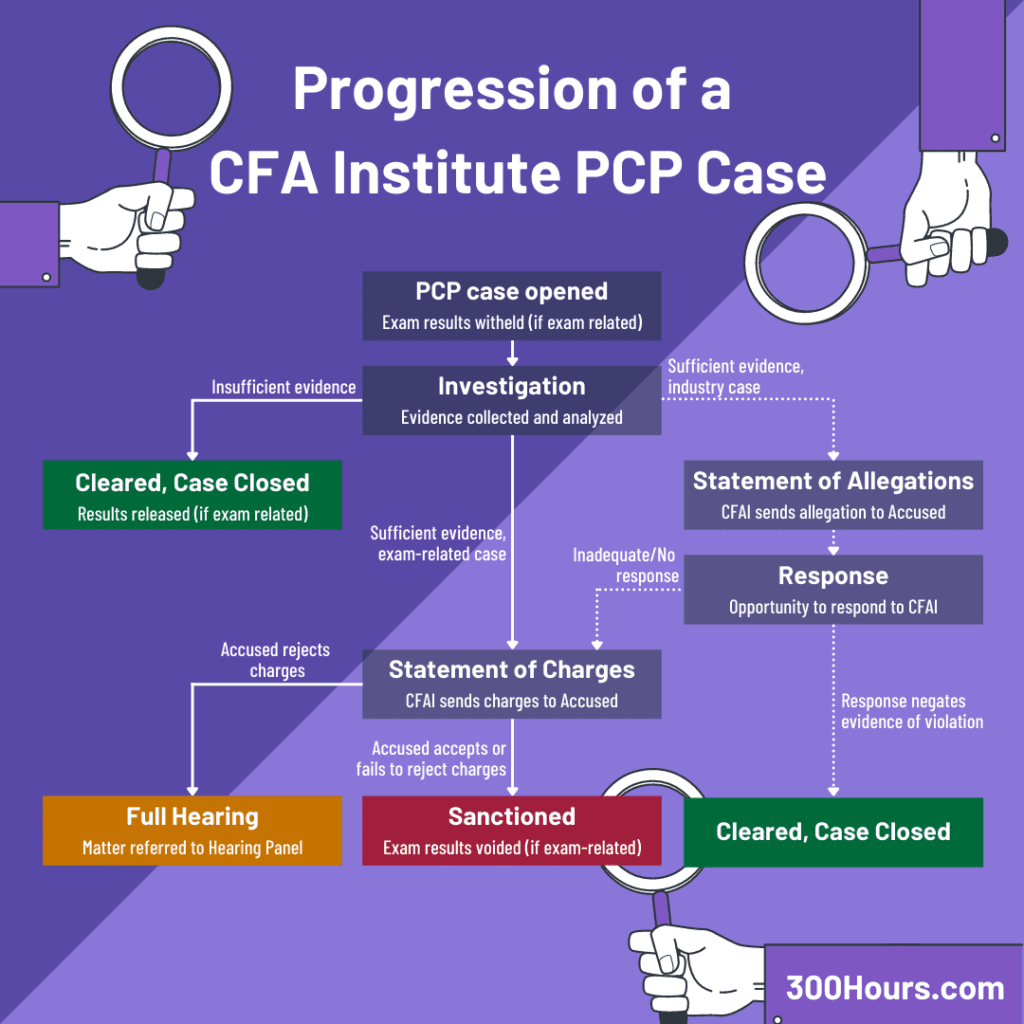
All disciplinary proceedings are conducted by members of the Disciplinary Review Committee (DRC) in accordance with the Rules of Procedure. The DRC consists of volunteer CFA charterholders from around the world.
Here’s a simplified flowchart to summarize the process for both exam-related and industy-related proceedings:
What kinds of disciplinary sanctions could be imposed?
The accused member or candidate may accept the recommended sanction or request a disciplinary hearing conducted by members of the DRC.
Here’s the list of possible CFA Institute PCP sanctions and what they mean:
| PCP CFA sanctions | Description |
|---|---|
| Private Reprimand | A written admonishment that includes only the conduct, excluding the person’s identifying information; it is not disclosed to third parties |
| Censure | A written admonishment that includes the conduct and may include the person’s identifying information; it is disclosed to third parties upon request. |
| Suspension of Membership | Termination of a person’s memberships, or opportunity for memberships, in CFA Institute and any member societies for a specified period. |
| Suspension of the Right to Use the CFA Designation | Termination of a person’s right to use the CFA designation for a specified period. |
| Revocation of Membership | Permanent or indefinite termination of a person’s memberships, or opportunity for memberships, in CFA Institute and any member societies. |
| Revocation of the Right to Use the CFA Designation | Permanent or indefinite termination of a person’s right to use the CFA designation |
| Summary Suspension | Automatic termination of a person’s memberships, or opportunity for memberships, in CFA Institute and member societies, as well as the right to use the CFA designation or participate in a CFA Institute Exam Program. |
| Suspension from Participation in CFA Institute Exam Program | Termination of a person’s participation in the CFA and/or CIPM exam programs for a specified period. |
| Prohibition from Participation in CFA Institute Exam Program | Permanent or indefinite termination of a person’s participation in the CFA and/or CIPM exam programs. |
Note that:
– A list of industry-related disciplinary sanctions issued since January 2000 are published on the CFA Institute website.
– Individuals who have received disciplinary sanctions of private reprimand or who have been sanctioned for exam-related conduct do not appear on the list.
– That said, sanctions for exam-related matters result in an automatic voiding of exam results.
Interestingly, industry-related disciplinary matters represents a relatively smaller portion of the issues, with majority of CFA PCP investigations being exam-related issues.
Let’s take a look at some datapoints.
What typically happens for specific types of industry misconduct?

CFA Institute’s Disciplinary Sanction Guidelines for professional conduct matters sets out typical sanction ranges for the most common categories of industry-related misconduct. Note these are guidelines, not fixed outcomes – actual sanctions depend on intent, harm caused, and aggravating or mitigating factors in each case.
| Misconduct type | Negligent conduct | Intentional or reckless conduct |
|---|---|---|
| Conversion or improper use of funds/securities | Censure to 3-year Suspension, depending on harm | Revocation/Prohibition is standard regardless of harm |
| Duty to employer (independent practice) | Private Reprimand to 3-year Suspension | Censure to Revocation/Prohibition in egregious cases |
| Duty to employer (leaving an employer) | Private Reprimand to Revocation/Prohibition in egregious cases | Censure to Revocation/Prohibition in egregious cases |
| Fiduciary duty (loyalty, prudence, care) | Censure to Revocation/Prohibition in egregious cases | 6-18 month Suspension to Revocation/Prohibition |
| Forgery | Private Reprimand to Revocation/Prohibition in egregious cases | Censure to Revocation/Prohibition in egregious cases |
| Inadequate supervision | Censure to Revocation/Prohibition in cases of gross negligence | 6-month to 3-year Suspension, or Revocation/Prohibition |
| Insider trading | Censure to Revocation/Prohibition in egregious cases | 12-month Suspension to Revocation/Prohibition (standard in egregious cases) |
| Market manipulation | 3-12 month Suspension to longer Suspension | 12-month Suspension to Revocation/Prohibition (standard if harm caused) |
| Plagiarism | Private Reprimand to 3-year Suspension in egregious cases | 3-month Suspension to Revocation/Prohibition in egregious cases |
| Suitability/excessive trading | 3-month Suspension to Revocation/Prohibition | 6-month Suspension to Revocation/Prohibition |
Industry-related PCP cases
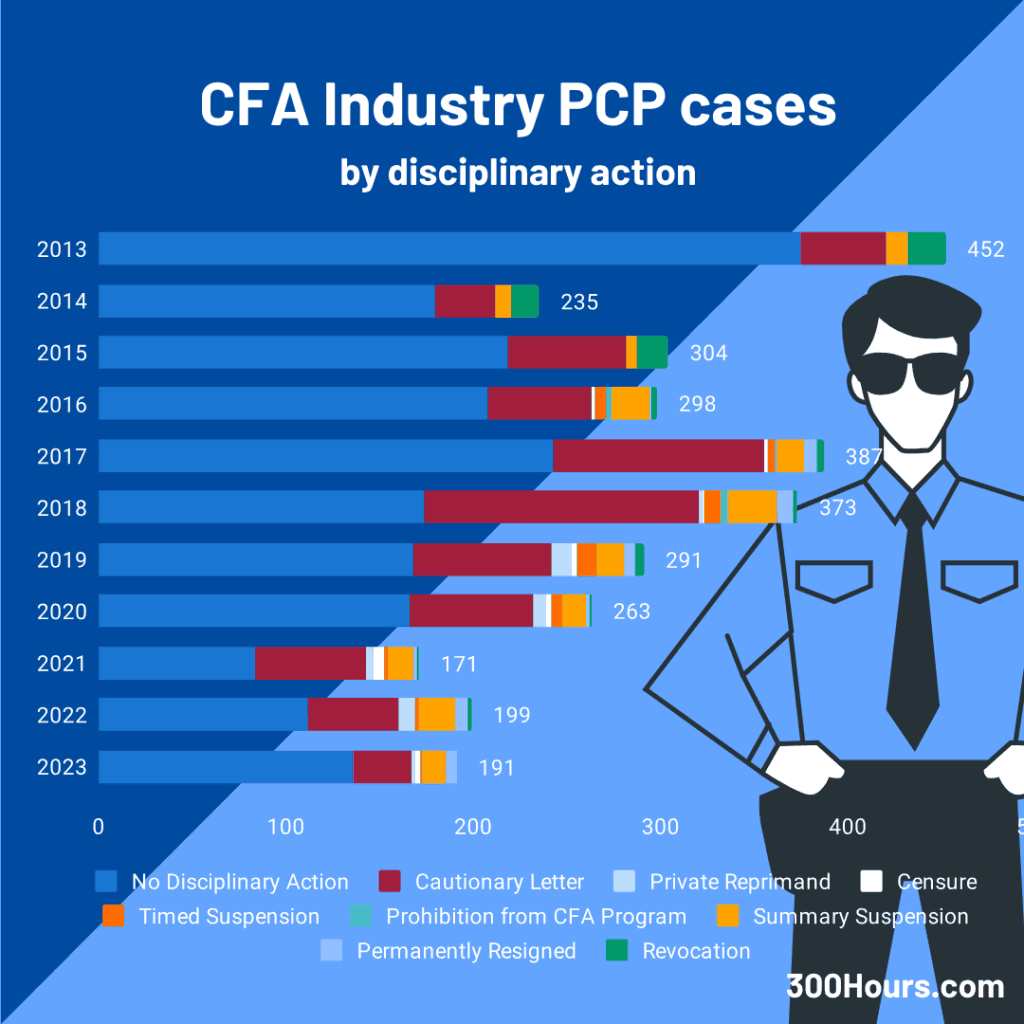
The above chart shows the industry-related PCP cases closed per year, and their resulting action (if any).
A few interesting observations across industry cases from 2013-2023:
- CFA Institute closed an average of 288 industry-related cases per year over this period, though annual volume has declined substantially since 2018 (373 cases closed that year, down to 191 by 2023).
- Most cases result in no disciplinary action (65.2% on average across 2013-2023), while cautionary letters (23.1% on average) cover most of the remainder.
- Summary Suspension (5.0% on average) and other disciplinary actions – Permanently Resigned, Revocation, Prohibition from the CFA Program, Timed Suspension, Censure, and Private Reprimand (6.6% combined on average) – form a small minority of outcomes, and have become rarer still in recent years.
Exam-related PCP cases
CFA Institute’s current Disciplinary Sanction Guidelines for exam-related conduct, effective 1 September 2022, sets out the sanction ranges typically applied for each type of exam misconduct under the computer-based testing (CBT) format:
| Violation | Sanction range |
|---|---|
| Unauthorized electronic device (no evidence of concealment or cheating) | Private Reprimand |
| Unauthorized electronic device (concealed, or evidence of possible cheating) | Two-Year Suspension – Prohibition from CFA Program |
| Creating a disturbance | Private Reprimand – Two-Year Suspension |
| Unprofessional or disrespectful behavior | Private Reprimand – Two-Year Suspension (or Summary Suspension if threatening) |
| Leaving the test center on an unscheduled break (no evidence of misuse) | Private Reprimand |
| Leaving the test center on an unscheduled break (evidence exam information was accessed or removed) | Two-Year Suspension – Prohibition |
| Possession of Candidate Body of Knowledge (CBOK) materials (no evidence of use) | Private Reprimand – Two-Year Suspension |
| Possession and use of CBOK materials while testing | Five-Year Suspension – Prohibition |
| Cheating (looking at another candidate’s screen or desk) | One-Year – Two-Year Suspension |
| Cheating (identical responses, tracking another candidate’s answers, or use of unauthorized exam question distributions) | Five-Year Suspension – Prohibition |
| Improper use of scratch paper | Private Reprimand – Prohibition, depending on volume and whether content was removed or shared |
| Disclosure or misuse of exam content | Private Reprimand – Prohibition |
| Misrepresentation (false registration/accommodation information, proxy test-taking) | Six-Month – Five-Year Suspension |
| Altering official exam results | Prohibition from CFA Program |
All exam-related violations also result in automatic voiding of the candidate’s exam results for the exam in which the conduct occurred, regardless of the sanction imposed.
What do I do if I’m under a CFA investigation?

Candidates typically get notified of a PCP investigation via email about 1 month after the exam.
It is totally normal to be freaking out, stressed and/or angry at such allegations, especially if they are not true. Allow yourself to feel those feelings for a while.
However, you need to accept that while this process can take a few months on average to complete, and there will be a delay to your CFA exam journey. It is a stressful and unpleasant position to be in, but do approach this matter calmly for your benefit.
Assuming you’re innocent, our advice is to:
- listen to the allegations respectfully, and then deny it if you didn’t do it.
- treat the process as a court of law, and focus on the facts when providing evidence to defend yourself.
- try putting yourself in the investigator’s perspective, and approach the matter logically and be civil.
- review your written answers/evidence to them thoroughly before sending, and not be in an emotional state when doing so!
The panelist are people too (volunteer CFA charterholders in fact), so hopefully they would understand what you’re going through, you have to take a shot at fighting your case if you’re innocent because no one else can.
One of our readers also wrote in about his personal experience of a PCP investigation with sage advice – check it out!
What are the odds of sanctions once a CFA Institute investigation starts?

We have some old 2017 data from CFA Institute on this, which is no longer published now.
Nevertheless, the statistics below is a useful guide on how strict this procedure is, and more importantly, why it’s best to avoid being investigated in the first place.
Looking at the historical cases that have been opened in the past exam cycles, there’s only a tiny percentage of cases where the case resulted in no disciplinary action – less than 2%.
Cases that end with anything worse than a cautionary letter will result in having your exam invalidated.
Statistically speaking, if the CFA Institute has opened a case against you, you’ve got:
- About 98% chance of receiving at least a cautionary letter
- 70-80% chance of getting your CFA exam results invalidated
- Approximately 50% chance of getting banned from future CFA exams, from 1 year to a permanent ban
- 20-30% of getting banned permanently from all future CFA exams
The best chance of staying safe is to never give CFA Institute a reason to open a case against you.
How to minimize the risk of getting a PCP investigation?

The potential career impact, stress and delay to your CFA exam journey just isn’t worth it.
To avoid industry-related PCP investigations, frankly you just need to abide by the Code and Standards, or any criminal activity really.
To minimize the risk of getting an exam-related PCP investigation, here are a few things we can learn from historical exam-related cases:
- Do not look around the exam room when your exam is in progress, as this may give the appearance of cheating (see next point). Focus on your computer screen or the ceiling, if you must.
- Don’t cheat in any shape or form, or have the appearance of doing so. Looking or glancing at another candidate’s exam or giving the appearance of doing so violates the exam rules and regulations.
- Only bring what is allowed in the CBT exam room, and only the approved CFA calculators.
- Stop writing when the exam time is up, although we expect this to be completely eradicated with the new computer based exam format (CBT), which automatically stops the exam when time’s up.
- Treat the proctors respectfully. Or anyone really.
- Don’t share or discuss past exam questions with anyone.
FAQs

A CFA sanction is a disciplinary measure CFA Institute imposes on a member or candidate found to have violated the Code of Ethics, Standards of Professional Conduct, or exam rules. Sanctions range from a Private Reprimand (a written admonishment not disclosed to third parties) up to Revocation – permanent termination of membership or the right to use the CFA designation.
Exam-related misconduct includes possessing unauthorized devices or materials, looking at another candidate’s screen or work, communicating with other candidates during the exam, disclosing exam content afterward, or misrepresenting information during registration. Industry-related misconduct covers broader violations of the Code and Standards, such as insider trading, market manipulation, fiduciary duty breaches, and misuse of client funds.
Censure is a written admonishment that includes the details of the misconduct and the person’s identifying information. Unlike a Private Reprimand, a Censure may be disclosed to third parties upon request, making it a more serious sanction even though it doesn’t suspend membership or the right to use the CFA designation.
CFA Institute accepts reports of possible misconduct through its Report Misconduct channel. Investigations can also originate from self-disclosure (required annually via the Professional Conduct Statement), CFA Institute’s own monitoring, or complaints from the public, employers, or other members.
Have you personally been involved in a CFA professional conduct investigation? Share your experience in the comments below.
Related articles